Latest News
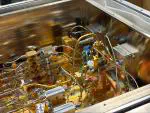
Before its shipment to the LMT, the FINER Band 6+7 receiver (210–350 GHz) is being used at NAOJ by DOSUE-RR, an experiment that searches for dark matter with radio waves. The team led by Okayama University, including Associate Professor Adachi, installed its own calibration and readout system on FINER and started the search for dark photons in the 0.9–1.4 meV mass range on 6 April 2026. See the announcement by Okayama University (in Japanese).
About FINER
FINER (Far-Infrared Nebular Emission Receiver) is a dual-polarization sideband-separating superconductor-insulator-superconductor (SIS) mixer receiver for the Large Millimeter Telescope (LMT) in Mexico. By exploiting ALMA’s new wideband sensitivity upgrade (WSU) technology, FINER covers a wide range in radio frequencies from 120–350 GHz, with an instantaneous intermediate frequency (IF) of 4–20 GHz per sideband per polarization, providing 40% of ALMAʼs light-collecting area, a similar atmospheric transmittance to ALMA, and a 5 times wider bandwidth than the current ALMA, which offers the most sensitive spectral-scanning capability among millimeter and submillimeter telescopes in the northern hemisphere.
The laboratory integration and evaluation of the full FINER system were completed at the National Astronomical Observatory of Japan (NAOJ) in October 2026, and the system is being prepared for installation on the LMT. FINER is expected to come online in 2027.
The FINER project is supported by JSPS KAKENHI: Grant-in-Aid for Scientific Research (S) 22H04939 (PI: Y. Tamura), Specially Promoted Research 24H00004 and International Leading Research 23K20035 (PI: K. Kohno), and Grant-in-Aid for Scientific Research (A) 15H02073 (PI: R. Kawabe).
Team
PIs
- Yoichi Tamura (Nagoya University)
- Takeshi Sakai (The University of Electro-Communications)
Development Team
- Masato Hagimoto (Nagoya University)
- Shun Ishii (NAOJ)
- Haoran Kang (NAOJ)
- Ryohei Kawabe (NAOJ)
- Takafumi Kojima (NAOJ)
- Sho Masui (NAOJ)
- Tac Nakajima (Suwa University of Science)
- Tai Oshima (NAOJ)
- Wenlei Shan (NAOJ)
- Tatsuya Takekoshi (Kitami Institute of Technology)
- Kunihiko Tanaka (Keio University)
- Akio Taniguchi (Kitami Institute of Technology)
Science Team
- Tom J.L.C. Bakx (Chalmers University of Technology)
- Yoshinobu Fudamoto (Chiba University)
- Yuichi Harikane (The University of Tokyo)
- Takuya Hashimoto (University of Tsukuba)
- Bunyo Hatsukade (NAOJ)
- Akio K. Inoue (Waseda University)
- Kotaro Kohno (The University of Tokyo)
- Yuichi Matsuda (NAOJ)
- Ken Mawatari (University of Tsukuba)
- Kotomi Taniguchi (NAOJ)
- Akiyoshi Tsujita (The University of Tokyo)
- Hideki Umehata (Nagoya University)
- Teppei Yonetsu (Osaka Metropolitan University)
- Yuki Yoshimura (The University of Tokyo)
Contact
- Yoichi Tamura
- Department of Physics, Nagoya University
- Email: ytamura (at) nagoya-u.jp